C6 of The Great Disruption - The Year That Growth Stopped

In this chapter Gilding argues that 2008 was the year that The Great Disruption started - that these two "crash" indicators occurred...
  • Resource limitations forced prices up
  • Ecosystem hit tripping points
He also recounts reactions to his arguments.

Ecosystem tripping points
  • Melting of northern icecaps accelerates, exposing dark blue ocean which heats faster which accelerates ice melting.
  • Melting of frozen tundra accelerates the release of large quantities of methane which is a greenhouse gas which traps heat which accelerates release of methane.
  • Ocean acidification increases which reduces the ocean's ability to absorb CO2 which prevents shellfish from forming shells and coral reefs from growing and heats the atmosphere.
Prices Going Up
  • Oil becomes increasing difficult to extract - easily accessible oil has all been found, is being used - meaning "peak oil" has or soon will happen. Oil price goes up. (The "new normal" for gas is well over $3 gallon.)
  • Global food prices go up (the "new normal" for a meal in a decent dinner is now $10) - because...
  • there are more people demanding more
    there is less arable land (due to development, overpumped aquifers, falling water tables, overallocated rivers, diminishing crop yields, expanding deserts, etc.)
    rich people (us) eat more and better food,
    corn is diverted to biofuel instead of food.
Reactions
  • When he first started presenting his story to social and business leaders Gilding was regarded as "intellectual entertainment" - written off as an "extremist and merchant of doom". Gilding's theory is that these are good people who have invested their professional and personal lives in the notion of growth. It had become a given, a fact of life not to be challenged.
  • After the crash of 2008 was well under way, Gilding got different reactions. The same leaders mentioned above felt that something was going - some change had happened. Many agreed in principle with Gilding - in the direction that things were heading, but were more optimistic that something could be done to forestall the ultimate collapse.
  • Gilding quotes Thomas Friedman (Flat Earth guy)... "What if the crisis of 2008 represents something more fundamental than a deep recession. What if it's telling us that the whole growth model we created over the last 50 years is simply unsustainable economically and ecologically and that 2008 was when we hit the wall - when Mother Nature and the market both said, 'No more.' "
Personal aside
I wonder if the current debt ceiling crisis is not a semi-unconscious reaction to the start of The Great Disruption. Both sides still talk about maintaining growth. Liberals say that we can spend our way back to 2.5% GDP growth and 8% unemployment. The semi-crazy tea party people claim that halting the growth of government will foster economic growth - maybe even a return to a pre-modern utopia where Billy Grahm and The Beaver reign supreme. However I get a sense that the craziest tea party people, the ones with the wildest eyes, those willing to go to the wall know in their non-sentient souls that more going on.

Related books
The smart systems at Amazon tried to sell me these books...
  • Prosperity Without Growth: Economics for a Finite Planet by Tim Jackson
  • Limits to Growth: The 30-Year Update by Donella Meadows
  • Beyond Growth: The Economics of Sustainable Development by Herman Daly

C3 of The Great Disruption

In Chapter Three of The Great Disruption, Paul Guiding notes that people have trouble understanding dire forecasts of global ecosystem studies because for the most part things look pretty good - at least in the developed part of the world. We are biologically programmed to respond to immediate threats. We don't naturally have the mental equipment to understand anything not happening in front of our noses; such insight has to be acquired. Guiding concludes the chapter by nothing that if we don't accept the science (which is about as unanimous as science gets) and wait for evidence that we can see it will be too late. The great disruption/collapse whatever will be on us. I think he will say in Chapter four that it almost is.

C4 of The Great Disruption

Changing economic/environmental practices has always been framed as a choice. If we change this thing we will avoid that thing - cause something else to happen. We always had a choice. Gilding's point is that the time of choice has passed. We didn't choose and now the results are on us. The changes required at this time are too great - the inertia of systems against change cannot be practically overcome. He says, "This means any hope that we can mobilize the massive intervention required to avert the crisis is a false hope. In combination the evidence all points to one conclusion. We cannot now avoid the the crisis of the Great Disruption."

C5 of The Great Disruption - Addicted to Growth

Gilding quotes a professor named Tim Jackson....

"The global economy is almost five times the size it was half a century ago. If it continues to grow at the same rate the economy will be 80 times that size by the year 2100."

(Yesterday, Bruce the leader of The Thinking Men - our semi-sober book club - and the voracious reader who suggested The Great Disruption sent around one of those email lists comparing things then and now. No air conditioning then, one or two lights per room, one car, no clothes dryer, manual push mowers, one small TV, etc. That's how it was a half century ago.)

Gilding's point is that such expansion cannot continue. It will hit the wall - several walls - the walls of finite reality. (In the last chapter Gilding cited a study which says that we are presently consuming resources at the rate of 1.4 planets.) The underlying issues are the loss of global biodiversity and changes to the global ecosystem. But the one that will grab us (by throat or crotch - pick your sensitivity) is the end of growth.

We are wedded to growth and its paired drivers, consumerism and stuff. Stuff, in quantity and quality, defines us. It is how we judge ourselves and other people - the cars we drive, the clothes we wear, where we eat, where we shop (Harris Teeter -vs- WalMart!). Growth is key to economic policy. An economy that does not grow at least two percent a year is a failed economy. Business is predicated on ever-increasing demand. Expanding populations require growth to create new jobs for new entrants into the workforce. But the demands of efficiency push automation which reduces the available jobs.

It is like a giant, system-wide Ponzi scheme that is about to collapse. It will probably go down in a non-linear fashion (maybe precipitated by a "Black Swan" event - maybe what is going on right now in Washington is that event) because that's how the curve goes - slow on the way up and fast on the way down with random stutter at the end - not a neat bell shape at all.

The other point Gilding makes is that none of this will be easy. He says that we are essentially addicted to growth and that like any addict will not willingly give up our drug. We will lie, fight, deny the reality in front of our noses. We will have to hit the walls of finite reality several times, really mess ourselves up before the truth penetrates our bloody, battered, dim-witted heads.

Multiple studies have shown that after basic needs are met (about $15K Per capita) increased wealth does not buy happiness.

A British study indicates that the "loneliness index" goes up with increased wealth.

Founders of economics did not propose continual growth. John Stuart Mill said that a "stationary state of capital and wealth... implies no stationary state of human improvement". John Maynard Keynes thought that the "economic problem" would be solved and that society would then "prefer to devote further energies to non-economic purposes".

And some quotes from Homer-Dixon's Upside of Down (another book read by the semi-sober Thinking Men - a much more elegant book in my estimation - the language of which makes you wonder where Gilding got the idea for The Great Disruption):

"Despite the fact that our lives are saturated with stuff, that we've already reached a level of material abundance unimaginable to previous generations, and that more money and possessions add little to our happiness, we must be made (by business) to feel chronically discontented with our lot."

"Our economic role in this culture of consumerism is to be little more than walking appetites that serve the function of maintaining our economy's throughput."

"Our psychological state is comparable to that of drug addicts needing a fix: buying things doesn't really make us happy except perhaps for the moment after the purchase. But we do it over and over anyway."

"Why? There are many reasons. But the central and often overlooked one, I think, is that consumerism helps anesthetize us to the dread of empty lives - lives that modern capitalism and consumerism have themselves helped empty of meaning."

old women

I see old women...

One running
a lawn mower
at 7:30 AM
to beat the
encroaching heat
stringy arms
tossing the machine
here and there
waving gaily
as I walk by

Another
bent down
arranging mulch
in her
already
immaculate yard

Two more
striding
side by side
arms swinging
short hair
sprayed into neat submission
cute
after all these years
greeting me
with wary smiles

Another
giddy
gone wild
with incipient dementia
tending two small dogs
straining into a bush;
she says in a wondering voice,
"They just have to smell everything."

To which
I reply,
"It is a grand adventure"

I only see
one other
old man

Where are the rest?

Do they sit inside
watching TV
eating entropy
getting fat on death?

Stuff


48 x 12


48 x 32


63 x 84


21 x 16


28 x 18 (approx 300 lb)


18 x 18


38 x 36


36 x 30

44 x 17

Dream

No attempt to make sense of this - more of a documentary effort, capturing images, impressions.

I was in a northern country, maybe Sweden. An indifferent intelligent place. I might have been with criminals, people who didn't belong here, who were up to no good.I might have one of them.

I met a girl in a public place, maybe a gallery that featured sparse bloodless art. She was thin and blond - pretty - not exactly friendly or inviting. She seemed bothered by something and suspicious of me. But she came with me anyway - as if I offered unlikely hope.

We were in a room and I noticed the ocean beyond the window. The water was covered in snow and ice but people played in it, swimming in paths they cleared through the snow and ice. They seemed to have fun, not to notice the cold.

I was asleep and she was nearby. I became aware that it was the most restful sleep in a long time. I savored that, at peace. Then I peered in the half light at the girl lying beside me. I saw her cat eyes looking back at me, amused but sympathetic.

Other Worlds


We talked about other worlds.

(Bob was told by a close relative who once worked in a criminal law office that two inches below the surface there is another world the rest of us don’t know anything about.)

I still think about it.
 
The place where they sold roasting hogs was another world.

Crossing the mountains into Burke’s Garden was like entering another world. In places the mist was so thick you could barely see the road, just hear the gravel crunch and feel the ruts, knowing that on one side the mountain loomed, unseen but felt, and on the other side the edge crumbled off into nothing. The road could have forked, gone somewhere else, and we would have not known it.


It was another world on the Appalachian Trial where I walked out to pee (knowing that I would write “I pee in the mist on the Appalachian Trial”). After a few hundred feet I could not see Bob or Big Boy (the Land Cruiser). There was just the sound of my own water splashing on the already wet ground and the whisper of wind in the trees, like the sound of old hymns. I could have gotten turned around and gone the wrong way into the wilderness.


The Burke’s Garden CafĂ© and General Store was another world.

We had crossed the last mountain and were in the valley, driving down a narrow paved road past well-kept farms. The mist had lifted but the sky was still overcast. At first the building seemed abandoned. There were no vehicles visible. But going past, lights shone from behind chintz curtains on the front windows. There was a sign. And in the parking lot on the other side, we saw an old Mercedes diesel sedan with a sooty rear bumper and a faded red Subaru Outback.

Note 9/27/2012 - Got this picture wrong. Here from the trip with Karen is where Bob and I ate. By 2012 the place was closed. The Subaru is Piggy.


I said, “Let’s stop here and eat lunch.”
 
Bob said, “Sure” and turned around.
 
We parked beside the Subaru (it had a Vermont tag; the Mercedes was from Virginia) and walked around to the front. I pulled back an unpainted screen door. Hinges creaked. Inside the place seemed bigger than outside. That might have been because the rear was filled with cases and shelves illuminated by a few dim lights. I could not see the back wall, just those individual pools of clarity.
 
But it was cheery up front, six tables on one side and a counter and small grill on the other side. A couple sat at one of the tables, heads inclined toward each other talking in low voices. They seemed middle aged. He was balding. She had short blond hair, suggesting a recent bout with chemotherapy. They were dressed in clothes that might have come from LL Bean, but not this year.
 
A tall woman wearing jeans and a baggy blue sweater stood at the grill, facing away from us. Her black hair was fluffy and streaked with gray. There were holes in the elbows of her sweater. Her jeans were snug but not tight. The left back pocket was frayed. When the screen shut she spoke over her shoulder, “Sit anywhere you like. I’ll be over in a minute.” She had high cheekbones like an Indian or a Russian. Her eyes were green. She wiped her face with the back of her hand.

Bob and I took the other table by the front window. Down the road to the left was an old white frame church. A rock wall bordered a large graveyard. Tombstones gathered on the hill like curious children.

Bob nodded toward the people at the adjoining table. “Good morning folks.”

The man glanced up; his lean face breaking into smile. “Morning.”
 
The woman nodded and smiled but didn’t say anything. Her thin face was pretty; her skin was translucent.

I said, “Interesting place. Unexpected.”

The man looked around as if he was just now aware of his surroundings, “Yes it is interesting.”

The woman spoke. Her voice had a fragile bell like quality. “But not unexpected.”

The brunette woman came out from the behind the counter. She placed plates in front of the couple and leaned over and patted the thin woman on the shoulder, her hand lingering like a caress. Then, walking over to our table, she pointed to a chalk board on the wall. “Gentlemen, my name is Grace. That’s what we have for lunch today. Drinks are tea, homemade cider, lemonade, coffee. Do you need a minute?”

We glanced at the board.

I said, “I see something. Let me try the scrapple sandwich. And I’ll have tea.”

The woman laughed, a throaty, rich sound. “Do you know what scrapple is?”

“Like North Carolina livermush, right?”

“You do know. Ours is home grown, put up right here in the valley. In the sandwich it’s fried with a slice of onion, cheese, mayonnaise and mustard. The bread is homemade, sliced thick.”

Bob snorted. “Thank you Grace. I’ll stick to the BLT. And I’ll have tea.”

The couple at the next table resumed their low conversation. Occasionally there was the sound of a fork striking a plate. They did not seem hungry. At one point the man reached across the table and touched the woman’s hand. I imagined that it must be like silk or parchment. She patted his hand on top of her hand.

Paws. That’s what Brenda and I called hands.

Bob and I talked about this and that. About the ghost town of Thurmond where we would go this afternoon. About Beckley where we had reservations tonight in a Hampton Inn and where tomorrow we would visit a coal mine.

In 10 minutes or so Grace brought our food. I was right. Scrapple was like livermush, but not quite as rich. Bob said his BLT was good.

Leaving our table Grace disappeared into the back of the store. She walked like a ballet dancer or an Indian. The couple stared into the shadows. In a few minutes Grace came back out. Looking at the thin woman, but speaking to both of them, she said, “Would you like to look around?”

Before the man could say anything the thin woman said, “Yes.”

They all walked to the back. The thin woman moved carefully, as if she might break. I heard voices then it was quiet.

Grace returned. Stopping at our table, she said, “Would you like a fried apple pie? The church ladies made them last night.”

Two Encounters

Story from trip described in travelblog, Big Trip Up North.

The Frenchman.

It was at the start of our day trip along the Cabot Trail around Cape Breton. We stopped at the Gaelic College gift shop, one of a dozen or so modest structures dedicated to the culture of the settlers of this part of Nova Scotia.


Out front, a boy wearing kilts played bagpipes in the misty rain. Later when I encountered the Frenchman I tried to imagine the music was martial but really it was just sad noise played by a wet kid. (Bob said the boy tried to get out of the rain but the big jolly woman who ran the gift shop made him stay out front where he could be seen and heard by potential customers.)

Bob went to the other end of the store looking for gifts which he would ask the gift shop to mail home to his family. I looked at smaller items that I could fit into my side of the BMW's trunk.

I was standing in line waiting to check out my few purchases when the Frenchman came in. I assumed that's what he was. A big handsome fellow with a roman nose, he had the same proud manner that I had come to associate with the French Canadian motorcyclists we encountered throughout Nova Scotia. Not exactly looking at anybody he seemed to offer to fight every man in the place. Standing up a little straighter, hearing the kid's bagpipe music, I imagined strutting over to the big man and saying something insulting to see what he would do. I could imagine getting in a lucky punch.

But I didn't start anything. Smiling at the puzzled man, who frowned then turned away, I paid for my items and went outside to wait at the car for Bob. I snorted to myself, at myself.

The woman and the old couple.

It was a modest place, probably depending more on locals than tourists. It's atmosphere was no atmosphere. Bob thinks it was below Digby, where the ocean-going ferry deposited us after our passage across the fog-bound Bay of Fundy. I think it was somewhere north of Halifix. (Where the previous night we had stayed in Sherborne NS at the Cape Cod Motor Inn - where Bob's TV didn't work and my commode quit at 2:00 AM.)


That doesn't matter. We stopped for lunch.

Our hostess told us we could sit anywhere. We picked a table at the front with a view of the parking lot. An old man and woman sat nearby. Across the room a group of women gathered at another table. One of the women was in her mid-forties. She wore a low cut sun back dress. Her skin was dusky smooth. Her eyes were big and her hair was curly and dark.

Breaking over from my vegetarian regimen I ordered a roast beef sandwich. It had thick slices of beef on white bread slathered in mayonnaise and mustard. I chewed the meat and every time I looked up the woman was there smiling at something one of her friends said. Twice she glanced at me then turned away.

Nodding toward the old couple at the other table, Bob mentioned that the man was certainly colorful. I agreed. I don't remember the exact colors - pastels, maybe a yellow shirt and blue pants. He also wore a fisherman's cap; it too was pastel. But his face was weathered and red, either from being outside or from drinking. (Bob figured both.) Obviously this was not the man's normal attire; that was probably a real fisherman's smock. Today he was dressed up to go somewhere.

When they rose to leave, the old man had to help the woman. He supported her as she shuffled out the door and down the steps to the parking lot. He was patient. She was dignified and accepting. I speculated that maybe they were driving from one of the smaller towns to a medical facility in Halifax, or some other bigger place. It was the sort of trip I was familiar with. Bob said maybe so and we both tried to see the car and the tag but there was a distraction and we missed it.

When it was time for us to go our waitress/hostess asked us if we were ready for our "slips". We were in a foreign country.

Leaving the restaurant I glanced over to the pretty woman. She did not look up, but I got the impression she had only just turned away.

It was my turn to drive. Perhaps I sauntered a little walking over to get behind the wheel of Bob's expensive little convertible, wondering if the woman could see me.

Then I remembered the old man.

Girl Who Looked Like Brenda

Story from trip described in travelblog, Big Trip Up North.


Both Bob and I thought that the young waitress at the Chili’s in Bennington, Vermont looked like a youthful Brenda - creamy tan, high cheekbones, serious manner, cat eyes, blond hair hanging in a loose braid off one shoulder. Like Brenda, she resembled the actress Kim Novak. When we returned to the Hampton Inn a few miles down the road I got the key to the BMW and went back out.

She had not been our waitress before. I said to the hostess, another pretty young woman, “Remember me?"

She claimed that she did.

Putting on my best Big Daddy manner, I asked, "Would yall please seat me at a table waited on by that lovely girl with the long blond braid?”

The hostess frowned. I waved my hands and added, “No, no child; don't get the wrong idea. I know I'm old enough to be her daddy.” Leaning forward I added in a confiding manner, “That’s who she reminds me of. My own little girl. I just had to get a closer look.”

The pretty hostess snorted. “This ought to be good. Sure. Why not. I’ll put you in Abbey’s section.”

She seated me in a booth separated from the bar by a Tiffany-style stained glass (plastic actually), partition. By this time the dinner crowd – family locals – had been mostly replaced by the bar crowd – single locals, their nasal New England voices getting loud and good humored just beyond my low wall.

Abbey showed up in a few minutes. She stood well away from the table. Her cat eyes were narrow; her full mouth neutral. Up close her skin was even smoother. I felt ancient. She said, “Yes.”

Big Daddy died. I managed to get out, "Ah, just coffee and dessert please. Apple pie."

Her face softened. She must have felt sorry for the old man who looked at her then looked away. "You asked for me?"

I said in my usual voice. "Yes, you remind me of somebody. You have heard that before?"

The corner of her mouth lifted a little. "Sure. " - she hesitated - " I am supposed to remind you of your own little girl. Right?"

I peered at her more closely. "Well actually you might look a little like her. But that is not who I had in mind. It's my wife."

She laughed. "That's familiar too. And where is she now?"

"Ah, she is dead."

Abbey's face dropped. "Oh". She added, "I've heard that one too. Yes, well, I'll get your order." As she walked away, I noticed that from the rear she was a little sturdier than Brenda, more like the real Kim Novak.

She returned in a few minutes with the pie and coffee, which she placed on the table before me. As she started to walk away, I said, "I am sorry if I made you uncomfortable. But you do look like her. I was in here earlier with my travelling companion - we are staying at the Hampton down the road - and both of us commented about the resemblance. I had to come back."

The girl hesitated. "When did she die, your wife?"

"About nine months ago."

"Where are you from?" Her smile now was friendly. "Somewhere south I know."

"North Carolina, near Charlotte. Have you ever been there?"

She shook her head, "Nope, never have."

As she stepped away again. I said, "You ever hear of Kim Novak? That's who you look like - who Brenda, my wife looked like."

She turned around and stared at me. "My mother told me that. I've seen some of her old movies. Picnic and Vertigo. It's sort of freaky. Your wife - Brenda - she did too?"

"Yep."

The girl looked at me closely. "You are not like that guy in Vertigo are you?"

"James Stewart?"

"Yeah the man who was trying to turn the second girl into the first girl - the one that drowned ."

I laughed. (My heart skipped a beat. Literally. That's what it does.) "No. I'm harmless. Just an admirer."

The girl smiled. "Well I've got to go back to work. " She reached down to touch my arm. Her hand was smooth. She smelled like fresh soap.

She said "Thank you for dropping by - ?"

"Tom."

"OK Tom."

"OK Abbey."

She walked off.

Later when she brought me the check and I left her a good but not immoderate tip she said, "Take care of yourself Tom."

I said, "You too Abbey."

It wasn't that night in Bennington but the next night, in Altoona, that I had the dream and woke up not knowing who or where I was - not remembering the dream except that it might have involved another woman and another life that was more real than where I was.

I say sir, who are you calling a bat?

Story from trip described in travelblog, Big Trip Up North.


(Tour bus - old people in distance)

The blind man with the cane started it. But the other was not blameless.

It was near Pleasant Bay on Cape Breton Island. One of those impossibly beautiful places where the land drops into the ocean. We had pulled off at an overlook, hoping that the sign was right and that we would see whales.

The first tour bus was already there when arrived. It had deposited about 30 - 40 seniors. Most stood at the rail looking out at the gray water. Some, pushing walkers or thrusting out with canes, roamed the parking area. Everybody seemed in good spirits.

No whales were in sight.

The second bus pulled in a few minutes later. The driver maneuvered around the first bus, tapping his horn to clear wanderers out of the way.

(Several of the wanderers seemed offended, which might explain what happened happened a few minutes later - the ferocity of it.)

A lady wearing a baseball cap and a blue wind breaker muttered "Asshole" as she scuttled to one side. A man, moving just enough to let the large vehicle creep by, said, "Stuff it." He carried his walking stick like a weapon . He might have been ex-military or police. Probably an NCO.

After the passengers from the second bus disembarked, the overlook became crowded. People bumped into one another. Walkers got tangled up. There wasn't enough room at the rail. There were muttered apologies and and a few complaints. ("Sorry". "You stepped on my foot." "Watch it." "Be careful." "Ouch.")

The last person off the second bus was a blind man. He seemed especially disturbed. He swung his white cane in wide arcs as he moved around the parking area. His ashen face was contorted in a grin or a grimace. I don't know where he was going. Nobody looked after him; his companions from the second bus stood out of the way. It was only a matter of time before he hit somebody.

As luck would have it his cane slapped the the leg of the man who had made the "Stuff it" comment.

The man bellowed, "Eooww! Watch what you are doing you blind old bat!".

The blind man stopped, pulled himself erect, and, turning in the direction where the other stood, said in a precise British accent, “I say sir, who are you calling a bat?”

The “Stuff it” commenter stepped closer. “You. You blind bat.”

The blind man cocked his head and seemed to concentrate. Then he swung his cane precisely in the direction of the “Stuff it” man’s cranium. However, “Stuff it” must have been anticipating the move because he raised his own stick to block the strike. He pulled his stick back, preparing a counter blow, but the blind man maintained contact between his cane and the other’s stick.

They moved around the parking lot like that, grunting, mouthing breathless curses. Occasionally the blind man would pull his cane back and take a swing which the other blocked. “Stuff it” never managed to get his stick free for a blow.

Members of the two groups offered encouragement, riders from the first group shouting, “Go Fred!” and those from second group yelling, “Whack him good Nigel!”

The two tour bus drivers tried to break it up but seemed reluctant to get in too close. (The driver of the first bus was tall and skinny; the driver of the second bus was short, fat and red-faced.)

After several minutes the participants were gasping for breath and the fight appeared to be winding down. That is when the driver of the second bus, angling into position to grab the blind man thrust his large butt into the stomach of the woman in the baseball cap and the little blue jacket. Screeching "you bloody oalf" the woman flailed out with her hat. Turning away from the flurry of blows, the driver stumbled over another woman from the first bus. She hit him in the crotch with a large handbag. He went "oof!" and staggered into another man - also from the first bus. This man, pink cheek and merry, pulled a canister of pepper spray (the Mace brand I think) from his pocket which he emptied into the fat bus driver's eyes.

The fat bus driver screamed.

Passengers from the second bus joined in to rescue their hapless driver. Insults were offered. Blows were exchanged. A general melee ensued. The parking lot was a sea of thrashing old bodies. Walkers were used as battering rams, canes as swords.

Bob and I managed to sneak away without getting involved. But as we were pulling off, a man, false teeth grinning through the sheen of blood that ran down his face leaned over the door of our open car and said, "I saw you two in Sydney. You really out to join us. It's loads of fun."

In the Gorham Cemetery

A story taking place in Gorham New Hampshire, near Mt. Washington, proud home of "the worst weather in the world." See the travelblog, Big Trip Up North.


Walking back down US 16 at 5:30 AM from McDonald's to the Gorham Motor Lodge. Not a serious walk; I was wearing my Crocs.

I stopped by the cemetery for a closer look at one of those vaults where they used to put people in the winter when the ground was too hard to dig graves. Like other vaults we saw throughout New England this one had a heavy metal door and was covered in earth and grass (Whitman's "grave hair"). The structure resembled a bunker that seemed designed not only to protect the inside, but the outside , as if the dead might spontaneously explode. (I can imagine them going off in late winter or early spring with a muffled "Whump!" and locals proclaiming, "Eh ah, waited too long on old Fester.")

Sipping coffee from my insulated McDonald's cup I wandered past the vault toward the back of the cemetery. The main drag was no longer visible and I was not surprised to hear a voice say, "Hello."

It was a man sitting on the edge of a large rock outcropping. He seemed to be wearing leather clothes. I took him to be one of the French Canadian motorcyclists who frequent this area. Beside him sat a huge dog - something like a Sheppard. The dog stared at me with yellow eyes. I could see no leash or collar.

I said, "Hello, how are you?"

The man said, "Just fine. Out for a morning stroll?"

His accent was not French Canadian - but something from further down the Appalachians. "Yeah. I was walking by, thought I would look around. Interesting place." I glanced at the dog. "You and your friend also out for a stroll?"

The man stood. It was odd. He didn't lean forward, use his hands to push up from knees. He just straightened up. He was big. At least six feet six inches tall. His hair was long and white. His motorcycle garb, if that is what it was, was brown and appeared to be hand-stitched. The dog also rose. The dog was not a dog but a wolf.

"You could say that."

"Your friend is a wolf I think."

The animal loped over to me. I held out my hand. He touched it with the tip of his nose, wagged his tail and stepped back.

"Yep, Sam is pure timber wolf. He likes you. I'd take that as a good sign."

"I do."

I had seen several motorcycles with side cars and persisted in the idea that this man and his friend were bikers. Gesturing toward the road, I said, "You and Sam ride in, stay at one of the motels in Gorham?"

The man gestured with a turn of his chin to the mountains behind us. "No, Sam and I are from up there - south of here. Sam likes cheeseburgers so we come into town every now and then. That crazy guy at McDonald's - you probably met him - brings them out back. " The man laughed. The wolf seemed to smile. "He thinks we are spirits."

"I saw that man. He was mopping the lobby. Are you? Spirits?"

"John - that's his name - has consumed too much weed. Messed up his mind. He thinks there are spirits up and down the Appalachians, on the ridges, in the woods. A 2000 mile wilderness filled with ghosts." The man laughed again. The wolf still smiled. "He sees yellow eyes whenever he drives through. He thinks we hide in the undergrowth, watch people go by."

"No wonder John is crazy."

"No wonder."

"Anyway, it would be boring - just watching."

"You can see a lot watching. And of course there would be other things to do."

"Of course."

The man turned and headed toward the shadows behind the last graves. He said over his shoulder, "Well, Tom, we have to go."

"How did you know my name?"

"A lucky guess. You look like a Tom. Come see us sometime."

He and the wolf disappeared into the woods. I walked back to the front. Bob rumbled by in the BMW. I walked to McDonald's for another cup of coffee and an orange juice.

John was putting out napkins.

I said, "Hello John."

He looked at me with crazy eyes.

The Execution

Story from trip described in travelblog, Big Trip Up North.


It was the damnest thing, when the reenactors grabbed that old man, him yelling in Japanese. I suppose it was our fault.

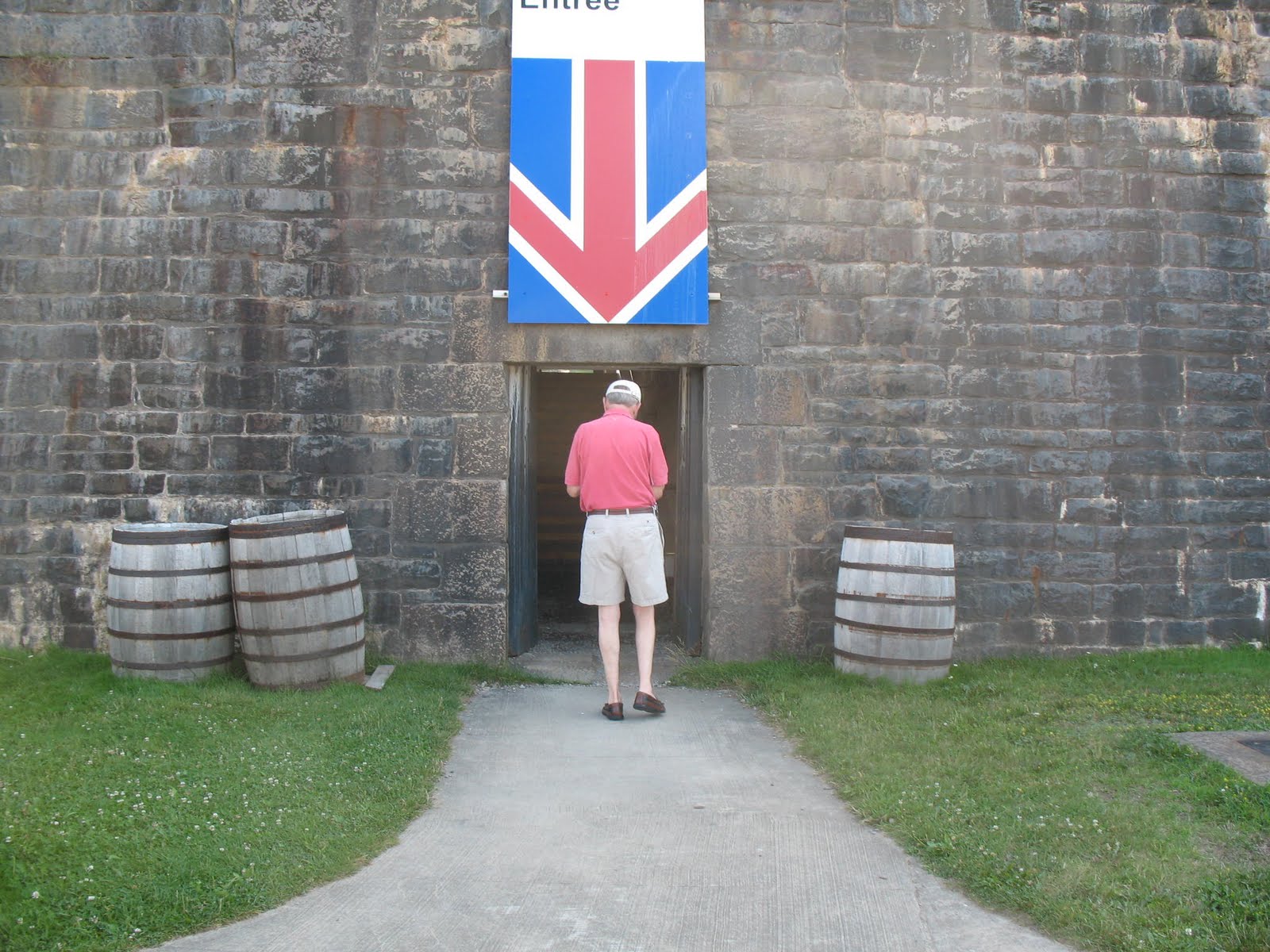
Bob and I had stopped at the Halifax Citadel, which is an old fort in the center of the city, strategically overlooking the harbor. We had time because the ferries from North Sydney to Port Aus Basques were all booked up by old people in campers and the trip to Newfoundland was out.

(When pausing too long at a complicated intersection we were yelled at by a young man in the traffic behind us. "Just go, go - sir!" Maybe that prompted Bob to drive up to the fort.)

We parked the Z4 in a lot at the top of the hill and walked through a passage in the wall to the interior. Bob said it reminded him of the fort in Puerto Rico near where he had been stationed in the Army. He was an MP. I think the fort was El Morro.

Inside was a large white gravel parade field, old barracks and other structures, including a gift shop where some tourists were gathered. Cannon emplacements were located around the top of the wall. A squad of reenactors, dressed in military kilts practiced drills. They'd march a couple of hundred meters this way, then do a turn or a wheel and go the other way. Their rifles seemed real.

I said to Bob, "I bet I could still march those men." and muttered, "hup thrup threep four, left,left, left right left."

Bob drawled, "Well you go ahead."

An old Japanese woman who was with an old Japanese man and several generations of family frowned at me. She wore a sky blue golfing hat with just a brim. Their little boy screamed like a samurai and went running off, crunching in the gravel.

The young man calling cadence for the squad of reenactors had a voice like a bull. He was accompanied by another pretend NCO who walked alongside the squad telling them to dress up the line, to straighten up, not to bounce. The boys, red faced and serious, seemed to get into it and for a time I thought they might be the real thing, maybe soldiers on loan from a local garrison. Bob thought they were silly.

Bob and I climbed to the top of the parapet, looking back down on the parade field and out across the city. The walk was about the same height as the town's taller structures. My friend Max once said he'd like to live here and I tried to figure out what made the place appealing. Maybe because it is a nice size and picturesque.

A boy wearing kilts and a khaki shirt was standing by one of the gun emplacements. At this point I still thought the reenactors might be actual military and asked him about that. He said, "Not really. Although some of us were in the Army. I was for instance."

Then I asked him if this fort had ever repelled American invaders. He grinned, "No, the Americans never got this far North."

Bob, who had been standing to one side, leaned over and drawled, "You know son, you could make these reenactments a little more exciting."

The boy said, "How's that sir?"

Bob pointed to a long brick wall at the base of the opposite parapet and casually advised. "Well you could stage a mock execution."

"Eh, an execution you say."

"Sure just grab somebody - a tourist even - and drag them over to that wall and pretend to shoot them. Don't even tell the person what is going on. Just take them kicking and screaming. It would be fun."

The boy said, "Uhm."

We walked on, continuing our tour of the parapet. Another group of pretend soldiers, dressed in different uniforms, were running signal flags up what appeared to be a ship's mast.

We were back on the parade field when the yelling started. Stepping around the barracks we saw four members of the reeenactor squad dragging the old Japanese man over to the wall. The remainder of the squad, led by our friend from the parapet, were forming into a line. The old man yelled and kicked. The old woman screamed and beat at the young men with her sky blue cap.

But the reeanactors, faces fixed into polite smiles, persisted and got the old man placed against the wall. Two held him more or less in position while the rest ran back to join the firing squad.

While the other tourists, including the remainder of the old man's family watched, the reenactor NCO quickly yelled, "Ready, aim, fire."

At "Ready" the squad brought up their rifles; at "Aim" they pointed them at the old man, (who now faced his executioners with stoic composure), and at "Fire" the group yelled out "Bang!"

After a moment, the onlookers, including the Japanese applauded. The old man's son, who was carrying an expensive looking Nikon, said, "Again please. I want to shoot a picture."

He said something to the old man who did not have to be restrained this time. The old woman still seemed mad. But at the command of "Fire" everybody yelled "Bang!".